Are evaluations of Microsoft Security Essentials unfair?

Microsoft Security Essentials has recently come under some criticism for poor test results.  The obvious, or maybe not so obvious, question to ask is how much of this is about the performance of Microsoft Security Essentials (MSE) and how much is it about testing methodology?  Is MSE  really so mediocre or are testers doing Apples vs. Oranges comparisons?

The core problem here is that many test organizations design their test regimes to test Security Suites (“demonstrate their capabilities using all components and protection layers“) and then apply those tests just to MSE rather than to the entire “Microsoft security suite” of which it is part.  Why?  One key reason is that Microsoft doesn’t explicitly offer a security suite, instead it spreads security capabilities across its products and components.  Rather than MSE being the cornerstone of its security efforts, as an anti-malware engine is for a traditional security vendor, for Microsoft MSE is a component that fills in a missing piece in the Windows security effort.

Why is this so important a distinction?  Simple, to get the full protection that a third-party suite offers you must be using the other components that Microsoft considers part of its suite.  If you don’t use, or don’t test, those components then you will indeed see less protection than you could get from  third-party suite.  To focus on a prime example, Microsoft has focused many recent security advances on Internet Explorer.  MSE does not try to duplicate those efforts, so if you use Firefox or Chrome you don’t get those benefits.  Meanwhile a third-party security suite will implement similar advances in a browser neutral way or provide add-ins to bring those capabilities to all popular browsers.

The most important advance in security technology the last few years is the use of Reputation to decide if it is safe to run a program.  With a reputation-based system you flip the security problem on its head, running programs you know are safe and either blocking or applying more scrutiny to programs whose safety is unknown or suspect.  This helps solve the problem that malware authors can write undetectable malware faster than anti-malware signatures can be updated to detect them.  That makes it particularly effective at blocking 0-day attacks, the area where MSE has been doing so poorly in testing.

The reason testing methodology is in question here is that Microsoft splits its use of Reputation over one (Windows XP),  two (Windows 7), or three (Windows 8) components.  MSE uses Reputation in all cases to decide if an image is safe and should be run without further evaluation or if it should be given closer scrutiny for its malware potential, but it doesn’t block execution just based on an unknown reputation.  Microsoft brought reputation-based blocking into the picture with Internet Explorer 9 SmartScreen on Windows 7.  With Windows 8 the picture expands even more fully with Windows 8 itself using SmartScreen reputation.  Basically Microsoft assumes that you are using IE9 and MSE together if you want the full benefits of reputation-based protection.  Use Firefox, Chrome, or another browser and you aren’t using Microsoft’s full security suite.  What browser due testing organizations use in their tests?  I don’t even think they reveal such details.

These testing methodology issues go beyond the reputation of executables.  Microsoft relies on IE’s SmartScreen for URL filtering as well.  Security Suite vendors offer their own browser add-ins for URL filtering, so they cover the major browsers and not just IE.  And Microsoft assumes more server-based filtering of email or catching bad executables when they are transferred to disk.  Security Suite vendors offer “end-point” (i.e., client) email filtering.  Test methodologies appear to intentionally try to force a requirement for end-point email SPAM/Malware filtering, putting MSE at a disadvantage.

So where does this leave users?  First, you can’t rely on the headlines as they don’t provide enough details for decision-making.  If you are a Windows 7/IE9/MSE/Hotmail (or Exchange with FPE/FOPE or another well protected email server) you are likely as well protected as with any of the security suites.  But if you start swapping out the components for third-party components, particularly browsers, then you may have cause for concern.  When paired with Chrome or Firefox  a third-party security suite probably does provide better protection than Microsoft Security Essentials!

What about Windows 8?  That is a more interesting story since SmartScreen-based reputation as well as the MSE-equivalent Windows Defender are built-in to the operating system itself.  Unless SmartScreen is intentionally bypassed by the testing methodology I would expect Windows 8 to fare better in testing than we’ve seen with MSE.  And if not, then Microsoft needs to really explain why users should feel safe despite the tests.

Posted in Computer and Internet, Microsoft, Security, Windows | Tagged , , | 26 Comments

OEMs continue to fail on the Windows 8 Launch

The more I wander around looking at Windows 8 in the retail channel the more frustrated I become.  There remains very little availability of systems that showcase Windows 8.  By that I mean, where are systems that make you feel you have to replace that old laptop or desktop that you are generally satisfied with?  For the most part stores are filled with very nice, but modest, revisions of the laptops/notebooks and desktops that were available a year earlier for Windows 7.  The myriad of announced, and in some cases heavily advertised, convertibles and tablets are AWOL.

On a recent visit to Australia I noted a tremendous amount of Windows 8 advertising by Microsoft, Intel, and the OEMs.  Images of the ASUS Taichi, Sony Vaio Duo 11, Dell XPS12, and numerous other convertibles and tablets filled TV screens, posters, and billboards.  Microsoft is heavily advertising the Surface, which in Australia is only available online.  I was hopeful that many of these advertised products had made their way into retailer and stopped at a few to check.

What a let-down!  Harvey Norman (kind of the Best Buy of Australia) had a couple of rows of laptops running Windows 8, but only a couple had touch screens.  Their all-in-one display was similar, with only a single system having a touch screen.  They had no convertibles and no x86 Windows 8 tablets.  The only tablet they offered was the ubiquitous ASUS VivoTab RT.  They had a brochure for the x86-based VivoTab but no actual device.  One might be forgiven for classifying Windows 8 tablets and convertibles as vaporware.

So the question for those watching Windows 8 adoption is this, what out there would drive rapid adoption?  There are plenty of goodies in Windows 8 for every type of system, but the real magic occurs when you throw in touch and new form factors.  When I walk into a retail store nothing says to me “your Toshiba Portege R705 is a dinosaur that you must replace”.

Today I think most Win8 adoption on new PCs is little more than a 1-for-1 replacement for sales of Win7-based PCs that would have happened anyway.  In other word, you were going to get a new PC in November whether or not Windows 8 was out.  Maybe you waited for Windows 8 since you might as well get the latest rather than deal with an upgrade later.  Or maybe you are taking advantage of deals as retailers unload Windows 7 PC inventory.

What you are not doing is saying is “even though I don’t really need a new laptop, I am going to get a convertible so I don’t have to carry a notebook and a tablet around with me all the time.”  You can’t say that because you can’t actually find one of those convertibles.  Vaporware?

I’m baffled by press, analysts, OEMs, and retailers who are complaining that Windows 8 isn’t saving the PC industry.  They still don’t get it.  Windows 8 couldn’t do a damn thing to make classic form-factor PCs so attractive that their sales would explode.  They represent a mature market with a steady to declining replacement rate as some scenarios are addressed by alternate form factors.  It is only by embracing the new form factors, including large screen touch-based devices, that the PC industry can reverse its decline.  And so far, other than Vapor, the PC industry has largely failed to do so.

Posted in Computer and Internet, Microsoft, Windows | Tagged , , | 13 Comments

A little commentary on recent Microsoft news

After a flurry of activity I expect my blogging to be light until the end of the year.  For example, I find myself with only 45 minutes to spare today.  But I did want to comment on a few things that were in the news this week.

Microsoft released a lot of data this week and Jon Box has a great summary.  This was carefully chosen data designed to tell the story Microsoft wants to tell while giving little additional insight.  I was particularly interested in some of the telemetry that was released.  Now here is  thought, why doesn’t Microsoft sanitize the telemetry and make it available in raw form so we all can analyze it to death?  Now that would be huge (but probably not wise)!

Let’s take a quick glance at the 40 Million Licenses sold number.  How many were upgrades?  How many were new PC sales?  How many were tablets?  Convertibles?  How many had touch screens?  How many of the 40 million are actually deployed?  How many purchased Win8 but then used downgrade rights to install Win7?  I don’t want to throw water on Microsoft’s Win8 parade, but the 40 Million number is almost meaningless without at least a few more details.  Ok, one more detail.  How many systems are actively running Windows 8?

Getting away from any negative thoughts, I was looking at some of the web browsing data from Statcounter and others.  Ed Bott pointed out via twitter that those 40 million Windows 8 licensed represented half of the entire Mac installed base.  Yes, in just a few weeks Windows 8 will be in use by more people than use OS X.  Assuming deployment is anywhere near license numbers.  Of course Statcounter shows that Vista is as common as OS X, so the bar is pretty low.  For all the Mac hype of the last few years it is almost an irrelevant platform.

IOS and Android are of course very relevant platforms, but not apparently when it comes to web browsing.  The October Statcounter data doesn’t include Windows 8 (either filtered out or included in Other along with Android).  I expect the November data will show Windows 8 has equaled or surpassed both Android and possibly IOS for actual web usage.  Of course there is one problem with Statcounter and its ilk, they are mostly used by smaller websites.  So the data might suggest that IOS and Android users avoid the long tail of the web rather than avoiding the web altogether.  Note that even if you factor apps in, using data that app and web usage are roughly split 50/50, IOS and Android combined would still only about equal Windows Vista and OS X.  So Windows 8 will have little trouble in surpassing them in importance to online services (web sites or services) within a few months.

I don’t know if this is related, but I’ve started to complain to websites that use Flash but aren’t on the Microsoft white list.  First one to respond was “Good news, we are moving to HTML5 in January”.  This makes the web better for everyone, but particularly for Windows RT.  I’ve noted other sites that tried to serve up Flash to my Surface a month go but now serve up HTML5 video.  They already used HTML5 for the iPad so this was a pretty simple change and it is nice to see they responded so quickly.  Seems to me like Windows 8, despite its support for Flash, is turning into the nail in the coffin that IOS built for Flash.

Of course Steven Sinofsky’s departure continues in the news.  Two comments here.  First, why all the angst over his departure?  Microsoft Office has shipped two top-notch releases since he moved to run Windows.  Whatever your opinion of Sinofsky he creates very stable teams and processes that live on long after he moves on.  As with the loss of Jobs at Apple, Steven will most be missed the next time some kind of major change is required.  And that should be years from now when, hopefully, new leadership will be ready to handle it.

The second comment is on collaboration.  Collaboration is not when you use big sticks to get people to line up behind you.  It isn’t when the message is “you’re either with us or against us”.  It isn’t when your mutual boss shows up every week and says “what are you doing to support Windows 8?” and makes it clear you’d better get in line.  True collaboration is reciprocal.  It includes when you show up and say “I need X, Y, and Z” you get told “we can do that for you”.  Or “we can do X and Y, could you live with Z’ instead of Z?”  It includes you doing things to help me further MY business.  H0wever people lined up behind Windows 8 I don’t think most teams felt it was collaborative.  They did it either because they recognized the opportunity or because SteveB twisted their arm.

Enough for today.  I hope everyone is already enjoying the holiday season!

Posted in Computer and Internet, Microsoft, Windows | Tagged , , , , | 3 Comments

Is Windows RT the ultimate example of using Telemetry?

I’ve long been thinking of doing a series of postings on both Microsoft and the industry’s use of telemetry and was about ready to start when I realized I’d rather put a cart before the horse.  Many have scratched their head about Windows RT, and in particular its lack of support for third-party “desktop” apps.  Ultimately I think Windows RT is the result of heavy reliance on telemetry.  Those who have bones to pick with Windows RT will, of course, think of the adage “there are three kinds of lies: lies, damn lies, and statistics” since it is statistical analysis of telemetry that we’re really talking about.  On the other hand, reliance on statistical analysis may explain why the end-user reaction to Windows RT and Windows 8 overall seems much better than that of pundits and power users.  It’s hard to be positive on something when you are looking at it from a perspective more than a couple of standard deviations from its design center.

Lots of inputs go into every decision, most importantly data.  With all decisions data is in short supply (thus the adage that management is the art of making decisions with incomplete data).  One might imagine that if you had perfect data then decision-making becomes easy, because the answer becomes obvious.  Typically you are forced to fuse data from multiple sources.  The more sources the more potential error that is introduced into the analysis process.   Often those sources are themselves the output of analytical processes rather than raw data, introducing their own errors.  Thus you get some of life’s truly head-scratching bad decisions, like New Coke.

But what if you had near perfect data?  What if instead of small sample sizes, limited sampling techniques, reliance on anecdotal data, etc. you had a sample of both overwhelming size and accuracy that you knew without a doubt that it clearly represented reality?  Could you make better decisions?  In particular could you make better decisions when high risk and complexity were involved?  Well, that is something the grand Windows 8 experiment will eventually tell us.

When Windows Phone 7 was being designed the App Platform team would look at the top 100 iPhone apps to make sure that the platform could do a good job of supporting them.  Customer usage patterns were thus driving decisions, but it was an indirect data set.  The Windows 8 team could look at this same kind of data, but it could also look at the massive amount of telemetry Microsoft collects from those who opt-in to its Customer Experience Improvement Program (CEIP).

Anyone who followed the Building Windows 8 blog could see how seriously Microsoft used the CEIP telemetry in making decisions about the Windows 8 user experience.  Dropping the Start Menu in favor of having even desktop-focused users jump into the Start Screen is an example of a decision driven by what telemetry told Microsoft about average user usage patterns.  Of course if you are in the minority of users with a usage pattern far from the average than you aren’t happy about what Microsoft did.  And further, just because the data told Microsoft how people actually did things doesn’t mean the resulting design decisions Microsoft made are the right ones.  The data didn’t say users wanted a jarring transition out of the desktop whenever they needed to start a new application.  Microsoft could have made some design tweaks that stuck with the Start Screen idea but made those transitions less jarring.

It may be a little off topic but let me give you a simple design change that might have made the Windows 8 experience smoother.  I don’t think it violates anything one would learn from the telemetry, but rather on a statistical level would make even those out around two standard deviations happier.  Provide a snapped view of the Start Screen that could be invoked from the desktop.  I’m guessing that half of the negative Windows 8 reviews would switch to neutral or positive.

So let’s go back to Windows RT and the Surface and how telemetry might have figured into the key design decisions there.  Recall Netbooks.  Five years ago the notion that most computing was moving to the web, and thus all users needed was an inexpensive web browsing device, took hold.  Moreover it was recognized that these devices would often be secondary devices that complemented rather than replaced existing PCs.  Since Netbooks didn’t have to run existing Windows-based apps Netbook manufacturers initially focused on Linux as the Netbook OS.  The rapid unit growth in Netbooks forced Microsoft to pay attention, initially offering a lower-cost Windows XP and then introducing Windows 7 Starter.  Despite costing (from my observation) about 15% more (both from OS costs and the need for slightly beefier hardware than their Linux-based counterparts)  Windows-based Netbooks eventually captured over 90% of the Netbook market.

Netbook market share growth then topped out, becoming a sizable niche within the PC space, before being hit by a triple whammy.  By 2009 Apple’s introduction of, and rapid growth in, the iPhone’s App Store had provided an alternate model to the movement of all apps to simply being web sites and it had decent web browsing capability as well.  Then the distinction between Netbooks and “Thin-and-Light” Notebooks blurred as user demand for both focused more on the 11″ screen size.  Finally Apple’s introduction of the iPad provided a much better alternative to the Netbook for a device focused on web browsing while at the same time bringing the iPhone’s App Store along for the ride.  Netbooks all but disappeared.

Windows 8 design started before the introduction of the iPad.  Even as late as the iPad 2 launch many analysts still considered Tablets to be no more than a Netbook-like niche.  And until very recently the impact of Tablets on PC sales has come entirely from the shift of the previous Netbook market to Tablets.  So from a hard data perspective what Microsoft mostly had to go on in late 2009 and 2010 in designing Windows 8 and Windows RT was the CEIP Telemetry.

Let’s step further away from overall Windows 8 and focus just on Windows RT.  It was clear by 2009 that a huge ecosystem was growing around ARM processors.  Microsoft had been tracking, and even working on, porting Windows to ARM since early that decade.  Deciding to port Windows to ARM was the easy part.  Deciding what to do with it is where the telemetry probably came in.  And let me be clear this isn’t based on any knowledge of what actually happened, but I’d put money on it being within one standard deviation of the truth.

With the Windows Phone team focused on phones, and ARM processors clearly not being up to the task of (nor having any advantage in) powering full Notebook or Desktop PCs it was pretty clear that the Windows on ARM design center was for the classes of devices between the two.  At the time only one class device had substantial market share between phones and notebooks, the Netbook.  Again the iPad didn’t exist yet so neither its precise characteristics nor user acceptance of them was known.  That tablets with user experience characteristics similar to the iPhone could be predicted (especially since Microsoft’s internal push on Natural User Interface as well as its own Tablet PC experience suggested it as well).  So it was pretty obvious that Windows on ARM needed to target Netbooks, touch-enabled Netbooks, and tablets with similar characteristics to Netbooks.  How, in the absence of what we know today (disappearance of the classic Netbook and rise of the Tablet) could Microsoft make design decisions?  Telemetry.

Why did 90+% of users choose to pay more for a Windows-based Netbook than to go with a Linux-based Netbook?  If these devices were simply used for web browsing than the user behavior doesn’t make sense.  We can speculate on this of course.  Familiarity of UI, compatibility with devices such as printers, ability to run Windows applications (even though that is counter to the original idea behind netbooks), etc.  As I said we can speculate.  And analysts can survey customers and make their claims.  But Microsoft?  Microsoft has precise data from the CEIP.

Microsoft could look at data and see how much users printed and what printers they used.  Microsoft could see how often they used the USB port and what they did with it.  Microsoft could see how often they docked the netbook to make use of larger monitors and better keyboards and mice.  Microsoft could see how often they used WiFi, hardwired Ethernet, or 3G.  Microsoft could see what percentage of the time they used the web browser and what types of web sites they visited.  Microsoft could see what other applications they ran and how much time they spent using them.

And what do you think Microsoft got from the CEIP telemetry?  I’m guessing that they saw the vast majority of Netbook usage was for web browsing, with use of Microsoft Office representing a much smaller but still substantial portion.  And then I’m guessing they saw a dramatic fall-off with no apps really registering as significant.  Netbooks were basically web browsing plus Office machines.  Then they looked at the web usage and saw that a great deal of it matched the kinds of “consumption” apps that were popular on the iPhone and that they were going to target with the new Windows 8 “Metro” app model.  And they saw heavy use of traditional Windows features like broad peripheral support, network connectivity, etc.  Combine the actual usage data on Netbooks with the emergence of Natural User Interface and the re-invigoration of local apps that was demonstrated by the Apple App Store and you have Windows RT.

Some have asked why Windows RT doesn’t have the ability to run arbitrary x86 applications via emulation.  Well first that doesn’t seem all that technically viable.  DEC’s Alpha ran x86 apps via emulation, but recall that in any given semiconductor generation the Alpha was faster than the equivalent x86.  That allowed it to run emulated apps with reasonable performance.  In any given semiconductor generation ARM processors are notably slower than the equivalent x86 (though to date they’ve been more power efficient).  So emulating x86 apps on ARM would make most apps unusable.  But perhaps more importantly, if data from Netbooks shows that users didn’t run apps even on a native x86 machine in this class why would you need to emulate them on ARM?

Emulation isn’t attractive, but why not have supported third-parties who wanted to port their x86 “desktop” applications to ARM by providing the tools and allowing installation of third-party desktop apps?  Well of course there are those issues around power consumption, memory use, security, etc. that the new app model addresses but desktop apps would largely still suffer from.  Microsoft could have made third-party developers pay attention to those issues, as Microsoft Office did.  One issue is that it would have detracted from efforts to get third-parties to write to the new app model.  Moreover, why bother if the data from Netbooks showed that users didn’t actually run those apps on this class of machine?

It is unlikely many users ran Photoshop on Netbooks.  If they used Netbooks for photography then they likely used lighter weight apps of the type that were appearing on the iPhone and Microsoft expected would quickly appear in its own Windows Store.  As they analyzed the telemetry from Netbooks I think they found this to be the pattern, with the netbook experience proving that there was little actual customer usage of arbitrary desktop applications on a device in this class.

So take a look at Windows RT, or even better the Microsoft Surface, and realize what it is.  The Surface is the intersection of Netbook meets iPad.  It brings exactly what most users liked about Windows on Netbooks into the modern era while dispensing with much of the Windows world that Netbook users simply didn’t take advantage of.   It is exactly what users told Microsoft via their actual usage data, extrapolated from the historical Netbook world into the modern device world, they wanted.

Want another possible proof point?  Domains.  On one hand it seems odd that you can’t connect a Windows RT device to a domain, yet on the other how many Netbooks were Domain-joined?  Microsoft may have had many reasons for not including the ability to join a Domain in Windows RT, but whatever those were they could look at the Netbook data and conclude that the ability to join a Domain was not critical to this class of device.  Take a look at many of your own questions about Microsoft’s Windows RT decisions and you’ll likely find the answer is in Netbook usage patterns.

The use of Telemetry may explain why Windows 8, Windows RT, and the Surface seem to do better with average users than the pundits and power users out around and beyond two standard deviations.  Windows RT and the Surface are designed to actual usage data on a segment of the computing spectrum that was also derided by many pundits and power users.   A segment that garnered (as I recall) about 20% of PC unit volume before being obliterated in the “post-PC” shift.  If Microsoft has used its wealth of telemetry to build something that nails the real world usage scenarios that originally made Netbooks popular, while also being roughly as good as the iPad for the scenarios Apple optimized for, than they have a huge winner.  Even if pundits and power users don’t seem to like what they’ve done.

And if Windows RT fails?  Well it could be the result of pundits and power users convincing the target audience not to give it a chance.  Or it could be the result of poor design decisions being made despite having excellent data.  Or it could be a series of marketing, sales, and partner missteps that have little to do with the product itself.  Or it could be that particularly vicious form of lies known as statistics.

Posted in Computer and Internet, Microsoft, Windows | Tagged , , , , | 31 Comments

Is Microsoft making a dent in public perception?

Sometimes I see a headline akin to “Microsoft is cool again” and wonder if that could really be true.  Then I think about how Windows 8/Windows Phone 8/Surface advertising has replaced campaign ads as the reason I need to fast forward my DVR.  (Though I like the ads, I get bored after seeing any one ad a couple of times.)  But I’m always wondering, is this for real?  Are the ads and other promotion activities (and yes, courting bloggers and reporters is a promotion activity) reaching the general public?  Yesterday I had another experience that made me believe Microsoft is breaking through.

My wife and I were having lunch when the teenage waiter came by and (noticing our phones and tablets) said “How cute, she is all Apple and you are all Microsoft”.  Now the fact that he even knew what my phone (Nokia Lumia 900) was and, likely having caught a glimpse of the Start screen, knew I had a Windows 8 tablet of some kind, is a huge victory for Microsoft.  And Nokia by the way, since their iconic Lumia look must be sinking in.  Of course it gets better.

The next thing out of his mouth was “Is that the new Surface?” followed by “How do you like it?”.  Now as any early adopter of the Kindle or iPad knows, that very question is how the steam rollers that became those product families began.  We early adopters told people how we loved the devices, and they went from interested to the next generation of buyers.  And this kid is aware of and interested in the Surface.  Another point to Microsoft.

I was using the Surface in full-on tablet mode, the Touch Cover folded behind the device.   Seeing his interest I flipped the cover around and opened the stand so he could see the Surface in its most unique glory.  He looked like he was going to wet himself.  Give Microsoft another point.

Having a teenager recognize and be interested in their products is an amazing step forward for Microsoft.  The demographic cliff they face is that the under 30 crowd is distinctly Apple-centric.  Not only are they buying consumer products from Apple, but as they enter the workforce and then become its leaders they are bringing their technology preferences with them.  This is a key reason Microsoft can’t simply follow the advice of many pundits and drop its attempts to court consumers in favor of focusing exclusively on enterprise customers.

But for me the best was yet to come.  You see, I was in for quite a shock.

My iPad-loving wife pointed at my Surface, then at her iPad, and said “That is more useful than this“.

I was in shock because I’ve made minimal effort to interest my wife in the Surface.  Of course I rubbed the Touch Cover and built-in hinge in when I first got the Surface.  But otherwise I see no point, since she’s one of those people who hates to buy new technology before her current technology is obsolete.  That iPad is probably with us at least another year, unless she decides to test the Gorilla Glass by handing it to an actual Gorilla.

My wife’s comment about the Surface is simply the result of observing me using it.  Of seeing me easily complete tasks with the Surface that she finds tedious on her iPad.  She apparently hasn’t noticed that most of the apps on the Surface are less mature than the versions she uses on the iPad.  Or if she has, she expects (as I do) that it is a situation that will correct itself in reasonably short order.  What her observation suggests is that Microsoft’s design center for the Surface (and of course Windows 8) resonates with the public, even the iPad loving public.  Give Microsoft another point.

Sure this evidence is of the limited anecdotal variety, though it builds on and supports my earlier experiences.  It doesn’t mean that Windows 8 tablets, or the Surface specifically, are going to succeed.  It just suggests that Microsoft is getting through to consumers and striking a nerve with its new product offerings.  And that is something they absolutely had to do to have a chance of succeeding.

Posted in Computer and Internet, Microsoft, Windows | Tagged , , , , | 19 Comments

Thoughts on the new Windows leadership

I’ve had a number of people question if  Julie Larson-Green is up to the task of running Windows Engineering.  No one has questioned Tami Reller’s expanded responsibilities because, well, Tami is pretty much doing the same job she had before except that the buck now stops with her instead of falling on the shoulders of a division President.  So I’ll focus this post on Julie and her new role.  And moreover on the experiment it represents.

Over the last few years you’ve probably heard a lot about Microsoft’s move to a “Functional” organization style.  The entire company isn’t there yet, but it has been the way of things in the Office organization for many years and was brought to Windows by Steven Sinofsky.  When an organization goes functional the major engineering functions of Development, Test, and Program Management all report up to a very senior level of management.  Usually a Corporate Vice President or above.  In some cases, like Windows, a business unit President.  One grows through the management ranks by taking on greater responsibilities within their discipline, but gains no experience in multi-discipline management nor ever has outright ownership of a product or technology space.

This contrasts with Microsoft’s historical style of having product units of (typically) 30-80 people with the functions reporting to a Product Unit Manager (PUM), multiple product units reporting to a General Manager (GM), multiple GMs reporting to a CVP, multiple GMs and CVPs reporting to an SVP, and then multiple CVPs and SVPs reporting to a direct report of the CEO.

Just looking at this from a management development perspective that means someone climbing the management ladder first learns to manage individual contributors (as a lead), then learns to manage managers (that is, be a manager of a set of leads) within their discipline, and then learns to manage managers across disciplines (as a Product Unit Manager).  PUMs also learn what it means to take overall responsibility for “a thing”.  Sometimes it is a product, sometimes it is a feature area, sometimes it is a particular technology.  But they own it and they own the overall commitments for that thing.  The PUM role is primarily an engineering role, and those that show excellent leadership, good people management skills, ability to handle a wider scope, business acumen, strategic thinking, etc. go on to populate the ranks of General Management (which includes both the General Manager and CVP titles).

My point in going through this is to explain a big part of the head scratching about Julie being named to run Windows Engineering.  Historically someone coming into this role would have proven their multi-discipline management skills and ability to completely own and guide a “thing” multiple times before taking on something as senior as running Windows.  They would have held one or more PUM positions, one or more GM positions, and one or more (general management) CVP positions.  Because she moved to the home of the functional organization model fairly early in her Microsoft career Julie skipped this path and instead took on increasing responsibilities within the Program Management discipline.  She is well proven as a (I would say THE) senior leader of the Program Management discipline within Microsoft, but unproven as a general manager.

This isn’t just an academic distinction.  One day around 2000 there was a knock on my office door and I turned around to see a couple of HR people who wanted to talk.  The topic was “Why do Group Program Managers fail as Product Unit Managers?”  It seems that HR had noted that successful PUMs come out of the Development discipline while unsuccessful ones came out of the Program Management discipline.  Without getting into that specific topic, the point is that great success within a discipline is not an indicator of ability to succeed in multi-discipline general management roles.   That’s why my personal preference is to discover someone’s abilities at general management earlier in their career than when you hand them the reins of a multi-billion dollar product.   By the way, one can now find plenty of examples of successful GPM to PUM/GM/CVP transitions so don’t focus on the specifics of HR’s dated 2000ish observation.

How much of a problem is the fact that Julie hasn’t been proven as a General Manager?  For a good leader it represents a challenge but certainly not an insurmountable one.  Assuming Julie is surrounded by discipline leaders that compliment her strengths and together form a strong team her lack of general management experience might represent little more than a speed bump on the road to success.

Was Julie the most obvious choice to take over leadership of Windows Engineering?  I guess it depends on the criteria you use.  Do you want your leader to be the most experienced manager available, or the visionary who will press forward with a change that is already underway?  Sometimes you can have both, but often those are different people.

There were choices besides Julie within the Windows organization that Steve Ballmer could have elevated.  Jon DeVaan is one of Microsoft’s most experienced executives and has held numerous CVP/SVP general management positions over the years.  Recall that on Windows 7 he was Steven’s peer, with Jon owning the Windows Core OS and Steven owning the Windows Experience (née, Windows Client) team.   Jon would have been an easy choice to take over Windows Engineering based on experience.  Chris Jones, the owner of Windows Live for many years now, used to be a VP in Windows Client.  Etc.  Without knowing anything about how these other executives are currently viewed it might be hard to say why he chose Julie over them, but it is very important to note that Ballmer did have choices.  Julie didn’t get the position by default, Steve obviously believes in her ability to lead Windows forward.

There is another cultural aspect of placing Julie at the head of Windows Engineering that is probably at play in many people’s initial reaction.  When I joined Microsoft in 1994 there were two very distinct cultures at play, named for the (earlier) divisional structure of Apps and Systems.  In the Apps (what we now know as Office) culture Program Management was the leading discipline.  By way of example the developer who coded PivotTable in Excel told me that he really hadn’t understood what they were for or how customers would use them, he’d just implemented the spec that the Program Manager had written.  That would never have happened in Systems, where the Development discipline reigned supreme.  In Systems the Program Managers were mostly process people.  Technical discussions of nearly any kind were always with Developers.

Read the book Showstopper! if you really want to get an idea of the Systems culture, particularly as the influx of Dave Cutler and others from Digital Equipment Corporation mutated it.  A few months before the book came out I had my one 1990s technical discussion with a Program Manager in Windows, Bob Muglia.  After that I think it was Developers all the way.  When Steven Sinofsky and Jon DeVaan took over Windows they shifted the culture more towards Apps’ Program Management-centric one.  That set up the possibility of Julie running Windows Engineering.  But for those groomed in the Systems culture, or who idolize some of its most prominent adherents (e.g., Dave Cutler), Julie seems like an odd choice to run Windows Engineering.

So is Julie a good choice?  On a strategic level I think there was no one better positioned to finish the job of re-imagining Windows that started with Windows 8.  I have some evidence that Julie is indeed easier to collaborate with than Steven was.  And she’s inheriting from Steven a well-functioning engineering organization that, of course, she helped create.  She doesn’t have to fix anything (major) that I know of on the organizational or engineering process fronts.  That means she has time for her multi-discipline general management skills to mature while focusing most of her energy on completing the Windows re-invention.  Plus, by splitting the business and engineering responsibilities across two executives (and taking on the President responsibilities himself) Steve has kept Julie’s new role from being too much of a stretch.  So yes, I think Julie is a good choice.  Hopefully we’ll be able to look back in a few years and say that she was a great choice.

Posted in Computer and Internet, Microsoft, Windows | Tagged , , , , , , , | 9 Comments

A scenario where the Surface shined

My wife and I are in the process of planning a vacation.  Now I’ve used an iPad to do a lot of travel planning and booking, but always found it tedious.  Sure its simple enough to go in and book a hotel room or even a flight.  Or to read about a destination.  But really planning a trip was always much MUCH better on a PC.

Trip planning is very much a multi-tasking activity.  And while its data entry requirements are modest (compared to Office type activities) they require considerable precision.  Research a destination, check the driving time between destinations, figure out how long you want to stay, research the hotel, book the hotel, book activities, book flights, copy flight arrival information to your car reservation, enter frequent flyer information, repeatedly enter dates, credit card and other information, cut/paste information from place to place, make corrections to Worldmate or TripIt when they can’t extract information from confirmation emails you forward to it, etc.  All done in some amazingly choreographed dance.

Even without a keyboard the Surface is better than the iPad at these activities.  Being able to snap one app to the side for reference purposes while you are working in another app or browser tab is priceless.  And Surface does app switching, just swipe from the left, so much better than the iPad that it’s not funny.  But add the Touch Cover keyboard and now you have a night vs. day difference for this scenario.  Not only is app switching faster still (Alt-Tab, Ctrl-Tab, etc.) but all of those precision data entry tasks go from painful to easy.

Enter identity information incorrectly on an air reservation and you may be delayed, denied boarding, or (for those into worst case scenarios with the U.S. Transportation Security Administration) subject to a full body cavity search.  Have airplane tickets not match your passport and you may be denied entry into a country that requires you show a return ticket.  Get dates wrong on any reservation and you could be ruining your vacation.  It is hard to get this stuff right with your finger.  And on a complex trip the odds of you making a painful mistake seem to be in the 50/50 range.  With a keyboard and precision pointing device the odds are more like 98% in your favor that you’ll get it right.

We’re still working on vacation plans, but at this point about 70% of the effort has been done on my Surface, 5% on my wife’s iPad, and the rest on a large monitor PC.    Given the remaining tasks I expect the workload to shift a little further in favor of the Surface.  But the iPad?  It’s nice for reading about a destination, but that’s about where it stops being the best device for the task at hand.

Posted in Computer and Internet, Microsoft, Mobile, Windows | Tagged , , , , | 6 Comments

Are OEMs creating a self-fulfilling prophesy?

Having just written about the paucity of Windows Tablets in the retail channel I have to wonder if Microsoft’s OEMs are creating a self-fulfilling prophesy.  Microsoft came out with the Surface because the OEMs weren’t creating the kinds of products necessary to move the PC concept forward.  In particular Microsoft feared that OEMs would fail to create a tablet that was a viable alternative to the iPad.  OEMs decided to go slow on Windows Tablets, perhaps because of the Surface but more likely out of their usual conservatism.  Now it looks painfully obvious that the OEMs are failing to fill the retail channel with tablets, which sends the message to Microsoft that they were right to have come out with the Surface.

ASUS is the only OEM who seems to have gone full steam ahead with a Windows Tablet, and a Windows RT Tablet at that.  But even their offering is basically just a tweaked copy of one of their Android tablets.  It’s a nice device, but not something with the kind of innovation needed to stand out in the crowd.  Microsoft developed new technologies, ordered custom parts, and built new factories in order to bring the Surface to market.  OEMs seem to be sticking largely to the business of system assembly.

Despite lots of announcements, no other OEM has a tablet (be that pure, or one of the detachable convertibles,) sitting in stores where you can see and touch it.  And the only tablet maker doing any mass media advertising is Microsoft.  The broader take away may be that Surface is the Windows Tablet.  And if OEMs leave that notion unchallenged for long then they will find themselves locked out of the Tablet market.

On Tablets in general we very well could be heading towards a world in which the iPad, Surface, and Nexus along with the Kindle Fire and Nook Tablet dominate the market.  The OEMs, from mobile giant Samsung to PC giants like HP and Lenovo to the new tablet entrants from China will then battle it out for the crumbs.  And most of the crumbs will likely go to Samsung.

The wildcard here is the Surface, but not because there is really any question of its ability to succeed.  Microsoft left a huge gaping hole for OEMs to fill by restricting Surface distribution to its own retail chain and website.  The Microsoft Store has a retail presence about equivalent to a single mite on a herd of elephants.  Really, it is a near meaningless presence.  The entire rest of the retail channel is open for OEMs.  Best Buy, Walmart, Costco, Staples, Office Depot, OfficeMax, Radio Shack, mobile carrier stores, etc. (and their international equivalents) are, so far, reserved for the OEMs.  Amazon and other online retailers are reserved for the OEMs.  And one has to imagine that the traffic to dell.com and other OEM websites dwarfs traffic to microsoftstore.com by a few orders of magnitude.  The OEMs have an unfair distribution advantage, yet they are failing to press it.

Microsoft may have limited Surface distribution to protect its OEMs (as well as to avoid the dangers of ramping up Surface manufacturing too quickly), but they won’t hold back for long.  If Surface is hot, then struggling Best Buy would undoubtedly want to carry it.  Moreover, it might be a perfect signature product for the Best Buy Mobile stores.  And it wouldn’t surprise me at all if Staples executives are already all over Microsoft to let them carry the Surface Pro when it launches.  Or how about Barnes and Noble stores carrying the Surface as a big brother to the Nook line?  2013 could see the Surface line broadly available in retail channels.

I will bet a lot of the OEMs decided to concede the consumer tablet space as that isn’t where their strength lies.  And of course the holiday season is about consumers, not about sales to the business customers the OEMs rely on.  But the OEMs are making a mistake.  Pent-up demand for the Surface Pro, is large and growing fast.  Every Surface ad Microsoft runs is implicitly an ad for the Surface Pro.  A lot of people have looked at my Surface to reassure themselves about their plans to purchase a Surface Pro.  One IT Director is buying one himself to use at work, with plans to use it to convince his CIO that they should broadly commit to the Surface Pro.  Any reservations he had before disappeared as he examined and played with my Surface.

What is happening in the Holiday 2012 consumer market for Tablets will strongly influence what happens in the 2013 business market for them.

Without a distribution advantage, without name brand recognition (in the tablet space), without particularly innovative products, and without any clear advantage at all how will OEMs succeed in the tablet market?  The opportunity for them to stake out a piece of the market is now, and they don’t appear to be doing it.  Twelve months from now, perhaps only six, it will be too late.  It may be worse, missing this holiday season may be all it takes to lock them out of the market permanently.  They will cry that Microsoft pulled the rug out from under them with Surface, but in truth they will have done 99% of the damage themselves.  Surface will just be filling the void.

Emboldened by the success of the Surface and Surface Pro Microsoft will expand the product line.  Oh I suppose that a Surface Phone and a Surface Xbox (or other player in the 7″ space) seem inevitable and aren’t what the traditional OEMs should worry about anyway.  What about a Surface Pro 12 (something I’m totally making up)?  Based on my usage of the Surface I realized that the Surface Pro is going to be a much more serious competitor against Ultrabooks (and similar devices) then I’d originally suspected.  Except for screen size I can totally see my Toshiba R705 being replaced by a Surface Pro.  Come out with a Surface Pro variant with a 12-13″ screen and a matching (improved) Type Cover and Ultrabook manufacturers will tremble.  Even the Macbook Air will be in retreat.

Can OEMs change this story and reassert their place in the PC ecosystem?  Yes, if they move quickly.  They need to get their products into the retail channel ASAP and start promoting them as heavily as Microsoft is promoting the Surface.  They need to make sure the mindset that consumers walk away with is “Windows Tablet” rather than “Microsoft Surface”.  Microsoft, with its much larger Windows 8 promotion efforts, will actually help with this.  But only if the OEMs do their part.  We are one week away from Black Friday and the full intensity of this shipping season.  For OEMs, the window of opportunity is closing fast.

Charlie Kindel makes a good case for why Microsoft won’t ever truly become a hardware company.  But OEMs may be leaving them no choice.  Moreover, with Surface I think Microsoft smells blood in the water.  It may be Apple blood and it may be Android blood, but there is definitely OEM blood mixed in.  And we all know how sharks react to blood in the water.

Posted in Computer and Internet, Microsoft, Mobile, Windows | Tagged , , , , , , , | 10 Comments

Just how are those Windows 8/Windows Phone 8 launches going?

The good news, Microsoft is delivering on its promise to blanket the media with Windows 8/Surface/Windows Phone 8 messages.  But when I put my feet on the ground and took a look at local retail outlets what did I see?  For PCs in general things were looking pretty good.  The local Microsoft Store is crowded with people checking out both the Surface and all PC form factors.  Best Buy was crowded with people checking out new PCs running Windows 8.  The Dell Showcase made for a very prominent Windows 8 display.  Staples was empty overall, but had a nice display of Windows 8 PCs.  MicroCenter was crowded, also with people checking out new PCs, although unlike Best Buy it was a mix of Windows 7 and Windows 8 devices.  And maybe the best news, I heard sales reps competently discussing Windows 8 and in one case addressing the Start Screen/Menu controversy.  So that was the good news, but the bad news is far more important from a strategic standpoint.

There are just about no Windows Tablets or Convertibles in retail stores.  The same goes for Windows Phone 8 devices.  Let me get the later out-of-the-way and then I’ll go into the former in more detail.

I was in Denver’s Cherry Creek Mall yesterday and stopped in the AT&T Store to see the new Windows Phone 8 devices.  All they had were mockups, no live devices.  They suggested I try the Microsoft Kiosk (one of the holiday stores that Microsoft opened this year).  Well, Microsoft didn’t have any Windows Phone 8 devices either.  One of the sales reps told me that if there were any around he would buy one with his own money just so they had one to show people.   Ok, I think this situation is a big enough “insert appropriate vulgar phrase here” by Microsoft, AT&T, Nokia, HTC, etc. to warrant some kind of award.

Now back to Windows 8.  Windows 8 devices are featured prominently, often exclusively, at all retain outlets I visited.  The Microsoft Store features the Surface as well as ASUS VivoTab RT, and the Kiosk is the dedicated to showcasing the Surface.  But other retail outlets do not have tablets and they do not have convertibles, they just have traditional PC form factors.  Most of those feature touch, making for great Windows 8 experiences.  But where are the tablets?

I started my tablet-quest at Best Buy.  No Windows tablets in the PC area.  One convertible, a Lenovo IdeaPad Yoga 13, buried in the back away from the main display area.  I go over to their tablet display, filled with Android devices and a separate little table for the iPad, and find no Windows tablets.   I ask a sales rep if they have any Windows Tablets and he takes me over to the mobile phone area where a lone ASUS VivoTab RT sits lost amongst some Android mobile phones.  No signage attests to its existence.  I’ll give Best Buy a D-.  At least they had a tablet and a convertible, though they were making no attempt to feature them.  Things weren’t so good at a local Best Buy Mobile store.  They had no Windows Tablets of any kind, and the sales reps weren’t happy about it.  F.

How about Staples?  No tablets.  One Convertible, the Lenovo Thinkpad Twist.  D-

That Dell Showcase?  No tablets or convertibles.  The sales rep is in love with the XPS 12, but they haven’t sent him one to display yet.  They claim they are too busy meeting consumer demand to send out display models, which sounds good but you can tell the rep is tired of telling people that.  They’ve given him dates for the display unit a couple of times, but it still hasn’t shown up. F.

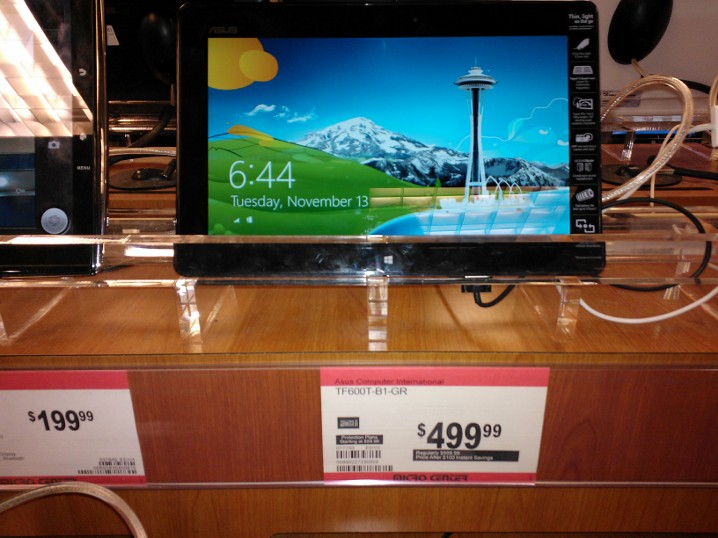
MicroCenter?  No convertibles.  After walking around the store twice I’m convinced there are no Windows tablets either.  Then I’m walking by a table displaying Android tablets and I see one of them lit up with the Windows 8 lock screen.  No signage lets you know that it is a Windows 8 tablet.  In fact, you can’t even tell what model it is unless you know that a TF600T is an ASUS VivoTab RT.  No I did not know, I looked it up.  F.

Only Windows Tablet at MicroCenter


While Windows 8 may be doing just fine with the traditional PC buyer, the critical task for Microsoft is to capture a healthy share of the market that would otherwise move to the iPad or Android tablet.  And they can’t do that if no tablets or convertibles are in the retail channel.  So I’m rather concerned by what I’m seeing in my tour of retail outlets.  If I just focus on tablets and convertibles the best grade I could give Microsoft is a D.  That grade goes up considerably if I consider how well traditional form factors with the addition of touch screens are doing.  But those are not what is going to change the market dynamics.  Microsoft and its partners have to get their range of tablets and convertibles into the broad retail channel.  NOW.

Posted in Computer and Internet, Microsoft, Windows | Tagged , , , , , , , | 21 Comments

Live Long and Prosper SteveSi

I was only momentarily shocked when I heard last night that Steven Sinofsky was leaving Microsoft.  It was momentary because a friend had told me months ago that Steven would be gone soon after Windows 8 launched.  The claim was that he had alienated most of Microsoft’s senior leadership, if not the bulk of the executive staff.  This was in the middle of all the outsider talk that Steven was in line to replace Steve Ballmer as Microsoft CEO.  While I never thought that likely, I found the notion that Steven would be forced out just as improbable.  And I take at face value Steven’s own statement that this was completely his decision.  Still, I don’t think this was simply a case of burnout, boredom, or desire to find a CEO job (as previous Windows President Kevin Johnson had done).

Steven had apparently lost recent battles to bring both Windows Phone and the Developer Division under his control.    I suspect that he saw those loses both as a roadblock to where he wanted to take Windows over the next few years, and a clear indication that his political power within Microsoft had peaked.  At the very point where he should have been able to ask for, and receive, almost anything as reward for his proven success he got slapped down.  And so he chose to leave.

It’s pretty clear from what was said, and not said, in the Steve and Steven emails that this wasn’t some well planned corporate transition.  It sounded abrupt, like the two of them met earlier in the day with Steven announcing his departure.  A friend with experience serving on public company Board of Directors was irate over how this was handled, feeling like modern corporate governance practices demanded a more planful transition.  I agree, and it is just one more indication that this move was probably an outgrowth of conflict.

Is this good or bad for Microsoft?  Probably both.  Microsoft has lost one of its few executives with a proven ability to ship major products and ship them on time.   On the other hand, it is also losing an executive who was tearing the company apart from the inside.  I have no doubt that a key reason Steven was unable to gain control of Windows Phone and the Developer Division is that most of the top 2-3 levels of leadership in those organizations would have quit.   So would senior leaders in other organizations, such as those with their own dependencies on DevDiv, as they realized their needs weren’t going to be met in the future.  It was becoming Steven against the rest of the company leadership, and no company can survive that situation for long.

What does this mean for Microsoft?  Does it mean a reversal of the cultural changes that have been occurring as Steven’s influence grew?  Does it mean that groups with dependencies on Windows, like the Windows Server team, will now find a better partner in Julie Larson-Green than they had with Steven?  Does it mean that Windows will slip back into bad habits?  I’ll comment more about these topics in the future.

I’m sure we haven’t heard the last of Steven Sinofsky, and he said as much in his farewell email.   It will be interesting to see what he does next, and if he can duplicate his Microsoft successes in another environment.

Steven, Live Long and Prosper.


Posted in Microsoft | Tagged , | 107 Comments